
Thirty players, 188% TGP: the NPC Spring Classic and the value of playing all day
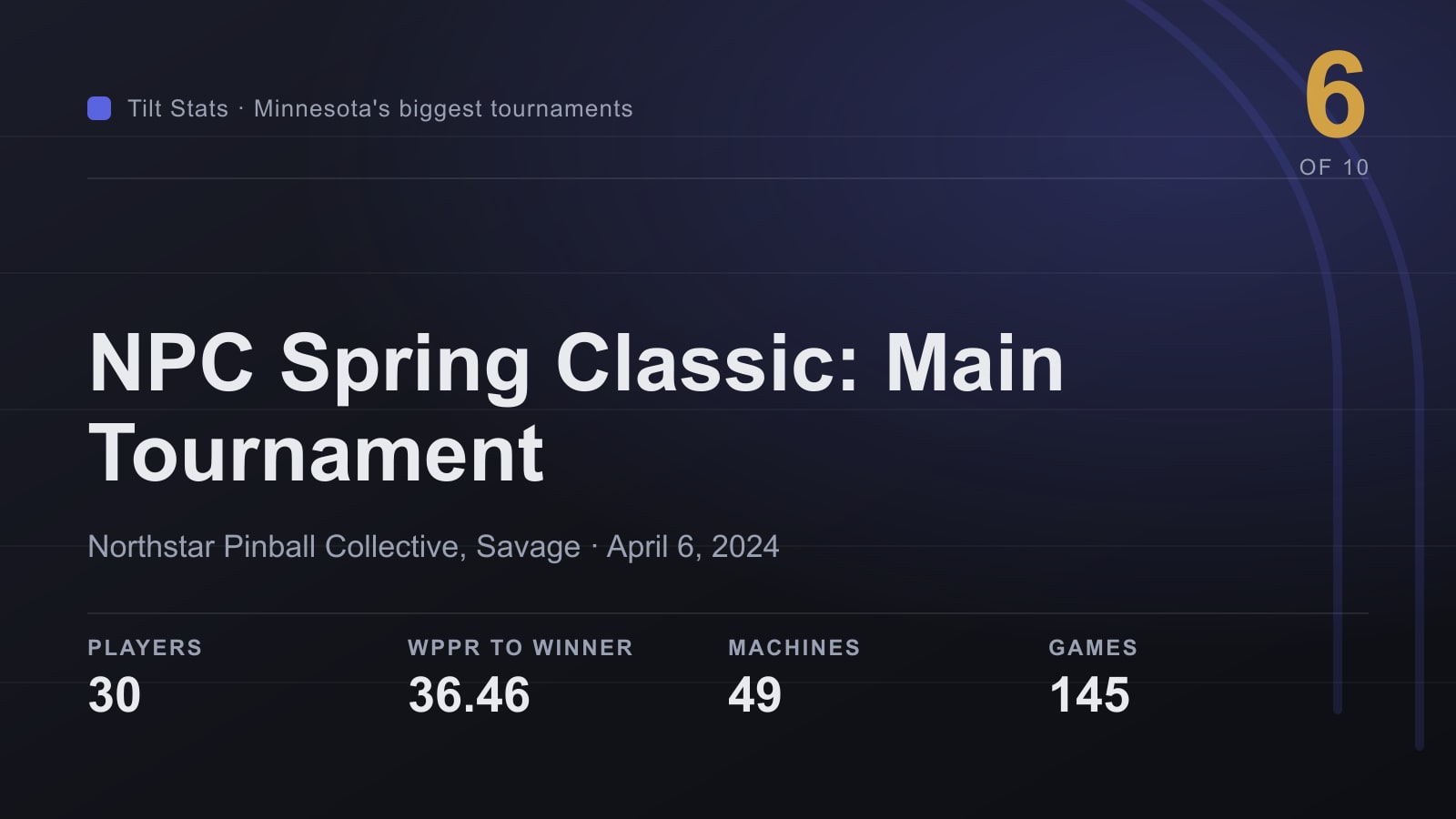
The smallest field on this list and one of the most valuable tournaments in the state. Thirty players, 145 games, forty-nine machines, and the world number six finishing eleventh in qualifying.
·5 min read·Tilt Stats
Thirty people. That is the entire field for the sixth-biggest tournament in the Minnesota data, and it is the best argument there is against judging a tournament by the length of the sign-up sheet.
The NPC Spring Classic main tournament ran on April 6, 2024, and paid its winner 36.46 WPPR points. The LITT October 2023 open, with eighty-five players, paid 37.17. Fifty-five more bodies bought seven-tenths of a point.
Why a thirty-player field is worth this much
Two reasons, and they compound.
The first is TGP. Match Play graded this event at 188%, close to the 200% ceiling, because everybody played sixteen games of qualifying before the finals even started. The IFPA scales a tournament's base value by how much pinball it actually required, and an all-day format nearly doubles what a short one is worth.
The second is who showed up. Twenty-seven of thirty players carried an IFPA rating and the average rank in the room was around 1,990, which is extremely strong for a local. The field included Luke Nahorniak at #6 in the world, Neil Graf at #18, Chris Frame at #129, Matthew Sommerfeld at #272, Keith Hanson at #381 and David Marcis at #411. WPPR value is driven by the ratings of the people you beat, and this room was almost entirely people worth beating.
| Players | 30 (27 IFPA-rated) |
| Format | Double-up matchplay, four-player groups, two games a round |
| TGP | 188% |
| WPPR to the winner | 36.46 |
| Completed games | 145 across 49 machines |
| Clocked playfield time | 69.1 hours, averaging 28m36s a game |
Forty-nine machines for thirty players is nearly two machines per entrant. At no point did anybody play the same game twice unless they wanted to.
The day the rankings went sideways
Qualifying finished like this:
| Pos | Player | Points | IFPA rank then |
|---|---|---|---|
| 1 | David Marcis | 33 | 411 |
| 2 | Jared Eshelman | 31 | 494 |
| 3 | Dan Stephney | 31 | 446 |
| 4 | Terry Weber | 29 | unrated |
| 5 | Chris Frame | 28 | 129 |
| 6 | Landon Acre-Kendall | 28 | 2,152 |
| 7 | Tony Midtling | 28 | 698 |
| 8 | Keith Hanson | 28 | 381 |
| 9 | Tate Nahorniak | 28 | 604 |
| 10 | Neil Graf | 27.5 | 18 |
| 11 | Luke Nahorniak | 27 | 6 |
The two highest-ranked players in the building qualified tenth and eleventh. Six players tied or nearly tied on 28. Across sixteen games, the spread from first to eleventh was six points.
The finals put things back roughly where the ratings expected. David Marcis won, Neil Graf came second, Luke Nahorniak third, Jared Eshelman fourth, Chris Frame fifth. Dan Stephney, who had driven down from Fargo and qualified third, finished sixth.
Marcis winning matters for his own record: he has eighteen wins across seventy-one tracked events, and this is the most valuable one of them.
The rivalry that would not quit
David Marcis and Jared Eshelman met eleven times on April 6. Marcis took it 8-3.
Their all-time record is twenty-one games across six events, 11-6 to Marcis. Half of everything they have ever played against each other happened on this one Sunday, and Marcis won two thirds of it.
Two more that are worth staring at:
- Luke Nahorniak vs Landon Acre-Kendall: nine meetings, 5-4 to Acre-Kendall. Luke was the sixth-ranked player in the world. Acre-Kendall was ranked around 2,150. He took the day series.
- Luke Nahorniak vs Neil Graf: nine meetings, 5-4 to Graf. All time it is 23-16 to Luke across ten events, so this was Graf's day.
Others: David Marcis vs Chris Frame nine meetings 6-3 Marcis, Mike Muggli vs Chris Frame nine meetings 7-2 Frame, Keith Hanson vs Bob Cahill eight meetings 6-2 Hanson.
The machines
Forty-nine titles, with the classics doing the heavy lifting on time:
| Machine | Games | Average |
|---|---|---|
| Metallica (Stern, 2013) | 6 | 25m16s |
| Terminator 2 (Williams, 1991) | 6 | 24m03s |
| Space Invaders (Bally, 1980) | 5 | 24m49s |
| Transformers (Stern, 2011) | 5 | 17m57s |
| TX-Sector (Gottlieb, 1988) | 4 | 42m21s |
| Monte Carlo (Gottlieb, 1987) | 4 | 36m29s |
| Paragon (Bally, 1979) | 4 | 32m26s |
| Jokerz! (Williams, 1988) | 4 | 32m01s |
TX-Sector at forty-two minutes a game is the slowest machine of the day by a distance. It is a 1988 Gottlieb System 3 with a reputation for long ball times in the hands of anyone who can hold the upper flipper.
The long ones
- 77m20s on Mustang (LE) in round one. Luke Nahorniak, Neil Graf, Tony Midtling and Landon Acre-Kendall, and it took an hour and seventeen minutes to sort out. Luke won it.
- 69m30s on Iron Maiden in round three, Luke again over Neil Graf, David Marcis and Jared Eshelman.
- 65m03s on Black Jack in round five, Mike Muggli first.
- 59m13s on Stranger Things in round two, Neil Graf first.
- 55m48s on TX-Sector in round two, David Marcis first.
The quickest full game was 8m22s on Metallica in round six.
Joe Heil's afternoon
Five of the eight biggest upsets at this tournament belong to one player. Joe Heil, ranked around 11,400 at the time:
| Round | Beat | Their rank | Machine |
|---|---|---|---|
| 1 | Jared Eshelman | 494 | Terminator 2 |
| 3 | Dana Platt-Nelson | 4,292 | Meteor |
| 4 | Daniel Hammond | 496 | Road Kings |
| 7 | Dan Hansen | 2,551 | Jurassic Park |
| 8 | Dan Hansen | 2,551 | TX-Sector |
Beating two top-500 players on the same day, on a 1991 Williams and a 1986 Williams respectively, is a genuinely good afternoon. Heil has 128 tracked events now.
Also worth naming: Dana Platt-Nelson beat Matthew Sommerfeld, ranked #272 at the time, on Space Invaders in round two.
Scores worth writing down
Mars Trek, a 1977 Sonic, produced the best raw scores of the day. Tate Nahorniak put 515,700 on it, with Aaron Hanson at 508,400 right behind him. Dan Hansen managed 504,600 on Prospector.
The lesson
If you want WPPR points, play the long events. Thirty people at 188% TGP outpaid eighty-five people at 100%, and it was not close in terms of effort per point. That is the whole design of the IFPA's system and this tournament is the cleanest demonstration of it in the state's data.
The full top ten
Ranked by the WPPR value paid to the winner, which folds field size, field strength and TGP into one number. Recurring events appear once, at their best edition.
- Last Chance at Lukie's 2025: the biggest pinball tournament in the Minnesota data
- Last Chance at Lukie's 2023: thirty-seven players, 233 games and a year-end scramble
- The NPC Amazing Race: fifty machines, sixty-nine players and a Friday night that ran past midnight
- Eighty-five players at LITT: the October 2023 open that set the template
- One hundred and one players: the Kentucky Derby Tournament at LITT
- Thirty players, 188% TGP: the NPC Spring Classic and the value of playing all day (this post)
- The day LITT opened: 87 players, 261 games and twenty-eight people's first tournament
- Sixty-five players, thirteen machines: Broken Clock runs the tightest room on the list
- Sam and Jared's farewell party: fifty-seven people show up to say goodbye
- NPC opening day: sixty-eight people in a brand new room, and Neil Graf wins eleven of twelve
Every number here comes from the tracked Match Play data behind Tilt Stats. Tournament, player, machine and venue pages update as new results land, so the live figures will drift from the ones written down above.