
Last Chance at Lukie's 2025: the biggest pinball tournament in the Minnesota data
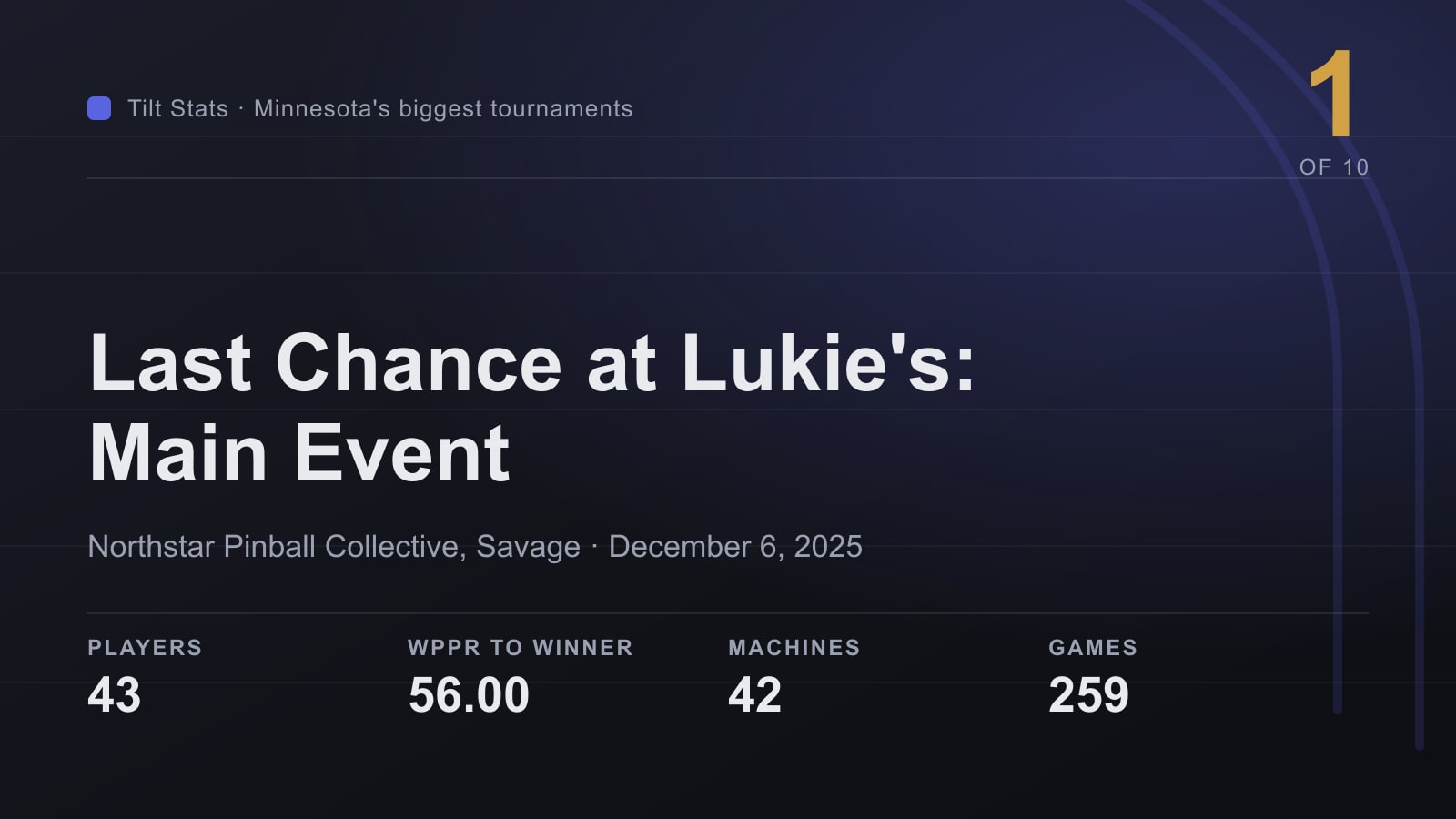
Forty-three players, 259 games, 161 hours of clocked playfield time and 56 WPPR points to the winner. A round-by-round look at the largest single payday in Tilt Stats' Minnesota records.
·8 min read·Tilt Stats
Ask around the Twin Cities about the biggest tournament of the year and most people will point at a room with a hundred names on the board. That instinct is reasonable and, by the way the IFPA actually counts, wrong. A hundred casual entries in a five-round knockout is worth less than forty regulars grinding through a full meta-qualifying day, because tournament value is field size multiplied by field strength multiplied by how much pinball you made people play.
By that arithmetic, the largest pinball tournament in the Minnesota data is a Saturday in Savage with forty-three people in it.
The numbers
Last Chance at Lukie's ran on December 6, 2025 at Northstar Pinball Collective, the collector-turned-clubhouse room on the south edge of the metro. Luke Nahorniak ran it. Doors at 10 in the morning, qualifying done around four in the afternoon, finals after that, and a $645 prize pool riding on the back end.
The format is the whole story. Seven rounds of four-player group matchplay, three games per round, with the games split across eras so nobody could hide on modern Sterns all day. That is twenty-one games of qualifying before anybody touched a bracket. Match Play graded it at 200% TGP, the ceiling, which is another way of saying you played enough pinball that the IFPA stopped giving you extra credit for it.
| Players | 43 (42 with an IFPA rating) |
| TGP | 200% |
| WPPR to the winner | 56.00 |
| Completed games | 259 across 42 machines |
| Clocked playfield time | 161.1 hours, averaging 37m19s a game |
Fifty-six points to first is the number that puts this event on top. Second place walked away with 39.97, third with 31.84. For context, a typical strong Thursday night in this scene pays its winner somewhere between eight and fifteen.
How it played out
Luke Nahorniak qualified first and did not make it close. He finished with 123 points to Louis Acre-Kendall's 105, and across the day he won 17 of the 27 games he played. He went into the weekend ranked #13 in the world, with a career best of #3, so the result is not an upset. The margin still raises an eyebrow in a format built to punish anybody who coasts.
Behind him the qualifying board bunched up in a way that made the bubble genuinely tense:
| Pos | Player | Points |
|---|---|---|
| 1 | Luke Nahorniak | 123.0 |
| 2 | Louis Acre-Kendall | 105.0 |
| 3 | Neil Graf | 103.0 |
| 4 | David Marcis | 101.0 |
| 5 | Matthew Sitko | 101.0 |
| 6 | Chris Frame | 101.0 |
| 7 | Zack Schuster | 93.5 |
| 8 | Luke Mutchler | 93.5 |
| 9 | Terry Weber | 93.0 |
| 10 | Keith Hanson | 91.0 |
Three players tied on 101. Two more tied on 93.5. In a field of forty-three, six points separated fourth place from tenth.
The A finals sorted it out. Luke won, Neil Graf took second, and Terry Weber, who had qualified ninth and quietly won 14 of his 34 games on the day, finished third. Chris Frame was fourth, Daniel Hammond fifth, Marshall Hilgemann sixth. David Marcis and Matthew Sitko, who had been tied for fourth in qualifying, both went out tied for ninth.
The machines
Forty-two different machines saw tournament play, which is most of NPC's floor. The room leans hard into electromechanicals and early solid states, and the pace numbers show it. These were the busiest, with average game length:
| Machine | Games | Average |
|---|---|---|
| Spirit of 76 (Gottlieb, 1975) | 8 | 54m08s |
| High Speed (Williams, 1986) | 8 | 46m10s |
| Mystery Castle (Alvin G., 1993) | 8 | 43m57s |
| Demolition Man (Williams, 1994) | 8 | 38m32s |
| TX-Sector (Gottlieb, 1988) | 8 | 38m26s |
| Paragon (Bally, 1979) | 7 | 50m39s |
| Royal Flush (Gottlieb, 1976) | 7 | 46m11s |
| Pro-Football (Gottlieb, 1973) | 7 | 41m32s |
Fifty-four minutes for a four-player game on a 1975 Gottlieb is a long time to stand in one place. Spirit of 76 has no ball save, no multiball and nothing to shoot at except targets, and a group of four decent players will churn through five balls each very slowly when everyone is playing safe. The modern games were quicker: The Uncanny X-Men averaged 28m17s, Iron Maiden 30m46s.
The long ones
The longest recorded game of the day is a curiosity. In round four of the finals, a two-player match on High Speed between Terry Weber and Chris Frame is stamped at 126 minutes and 9 seconds. Weber won it. Two hours on a 1986 Williams with a three-ball default is not impossible, but it is very unlikely, and the far more probable explanation is that the result sat on the tablet while the round waited on something else. Timing data comes straight from Match Play, and Match Play measures the gap between a game being assigned and the score being entered, not the gap between plunge and drain. Treat it as the longest gap, not the longest game.
The rest of the leaderboard is more believable, and more fun:
- 84m53s on Bounty Hunter in round five, with David Marcis winning a group that also held Louis Acre-Kendall, Zack Schuster and Neil Graf. Four of the top seven qualifiers, drawn together, on a 1985 Stern.
- 80m52s on Mustang (LE) in round four, Luke Nahorniak first.
- 80m24s on Avengers: Infinity Quest in round three, Luke again.
- 74m35s on Spirit of 76 in the last round of qualifying, David Marcis over Matthew Sitko, Luke and Louis.
At the other end, the quickest full game of the day was 8m54s on Wild Fyre in round five, won by Tim Chapman. Hold that name.
The upsets
Rank gaps here use each player's IFPA standing nearest to the event date, not today's, so a player who has climbed since does not get retroactive credit for a win they did not earn.
Tim Chapman had the day of his life. He came in ranked somewhere around 15,800 in the world, which is what happens when you have played a few dozen events and not yet had a big one. In round five he took all three games off Krista Larson, ranked near 2,700, on Wild Fyre, JAWS and High Speed. Then in round seven he beat Daniel Hammond, ranked around 620, on Jokerz!. That is a rank gap north of 15,000 in a single group.
Two more worth naming:
- Fred Gams, ranked about 10,000, beat John Schollmeyer, ranked about 1,800, on TX-Sector in round one.
- Luke Mutchler, then ranked around 7,600, beat David Marcis, then #275, on the same machine in round two. Mutchler has since climbed to around #1,464, so that one reads less like a fluke every year.
The rivalry the draw would not let go of
Neil Graf and Louis Acre-Kendall played each other fifteen times in one day.
That is not a typo. They were drawn into the same four-player group in rounds two, three, five and six of qualifying, three games each time, and then met again in round three of the finals. Fifteen head-to-head results in a single event, in a format that is supposed to spread you around a field of forty-three.
Louis took the day 8-7. Zoom out and it stays close: across every tracked game either has played, their all-time record is 25 meetings over seven events, 13-10 to Louis. Graf was ranked #19 in the world that December. Acre-Kendall was #897. The rankings have an opinion about this matchup and the results keep declining to agree.
Other pairs that kept colliding:
- Luke Nahorniak vs David Marcis, nine meetings, 6-3 Luke. All time: 99 games over 27 events, 50-33.
- Neil Graf vs Zack Schuster, nine meetings, 7-2 Graf.
- Chris Frame vs Luke Mutchler, nine meetings, 6-3 Frame.
- Matthew Sitko vs Daniel Hammond, nine meetings, 5-4 Sitko. All time they are dead even at 26-24 to Hammond across twenty events.
Scores worth writing down
Most group matchplay events never record raw scores, because the result is all the software needs. A handful got entered here, and the best of them came on the oldest machines in the building. Luke Nahorniak put up 102,450 on Sure Shot, a 1976 Gottlieb. Chris Frame managed 67,020 on Spanish Eyes, a 1972 Williams that predates the solid-state era entirely.
Why this one sits at the top
Nothing about the day was flashy. Forty-three people, a converted warehouse in Savage, no livestream. What made it the biggest tournament in the data is that everybody in the room played twenty-one games of qualifying against a field where forty-two of forty-three carried an IFPA rating, and then the top half played more. Value follows effort. This event asked for a full Saturday and the IFPA paid accordingly.
It is also the second time the same event name appears near the top of this list, which tells you something about how Luke Nahorniak builds a tournament. The 2023 edition is ranked second.
The full top ten
Ranked by the WPPR value paid to the winner, which folds field size, field strength and TGP into one number. Recurring events appear once, at their best edition.
- Last Chance at Lukie's 2025: the biggest pinball tournament in the Minnesota data (this post)
- Last Chance at Lukie's 2023: thirty-seven players, 233 games and a year-end scramble
- The NPC Amazing Race: fifty machines, sixty-nine players and a Friday night that ran past midnight
- Eighty-five players at LITT: the October 2023 open that set the template
- One hundred and one players: the Kentucky Derby Tournament at LITT
- Thirty players, 188% TGP: the NPC Spring Classic and the value of playing all day
- The day LITT opened: 87 players, 261 games and twenty-eight people's first tournament
- Sixty-five players, thirteen machines: Broken Clock runs the tightest room on the list
- Sam and Jared's farewell party: fifty-seven people show up to say goodbye
- NPC opening day: sixty-eight people in a brand new room, and Neil Graf wins eleven of twelve
Every number here comes from the tracked Match Play data behind Tilt Stats. Tournament, player, machine and venue pages update as new results land, so the live figures will drift from the ones written down above.